
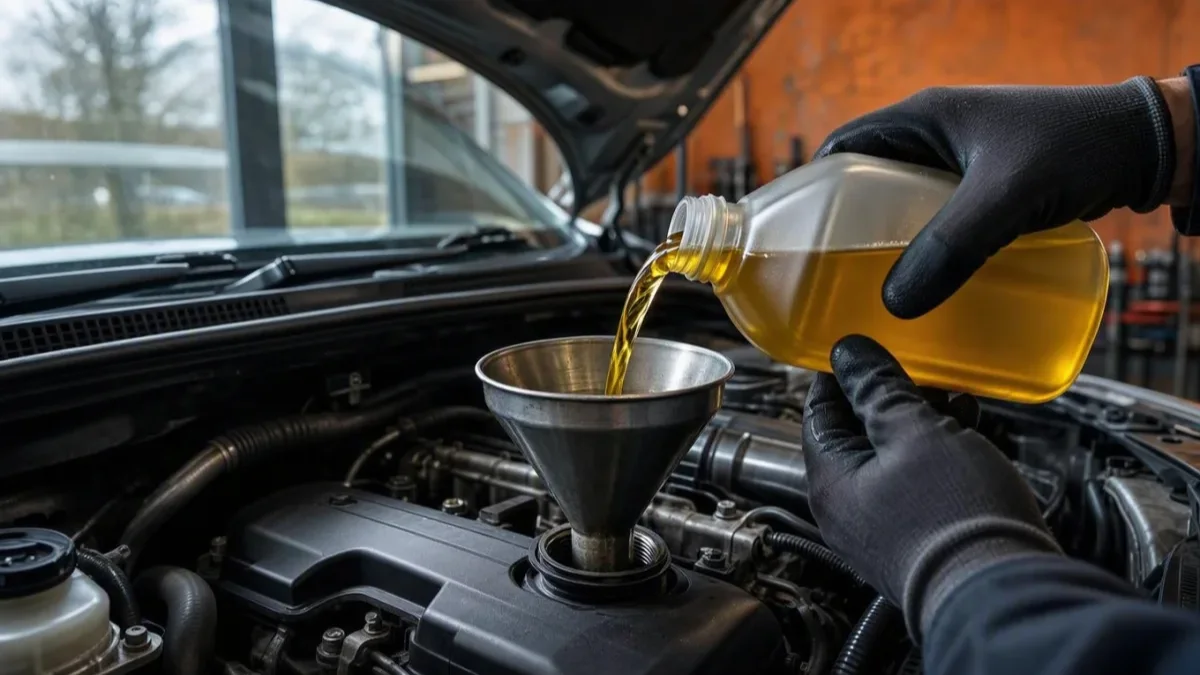
Ask five drivers how often oil should be changed and you get five numbers. The disagreement is real, because the number depends on something most people never mention: how the car is driven.
Heat Cycles Age Oil, Not Odometer Readings
The same 10,000 km is not the same wear in every car.
Engine oil degrades in two ways: heat and contamination. When an engine reaches full operating temperature, moisture inside the oil evaporates and the oil does its job properly. On short trips the engine never gets that hot, the moisture stays in, and the oil ages early.
So a car doing a four-kilometre school run twice a day is not on the same schedule as one doing a 300 km motorway trip every week. The second car often has healthier oil despite the higher mileage.
Rule: Short urban trips count as severe service. Aim at the lower end of your book's range, not the upper one.
Start With the Service Book, Not the Internet
Only one number is binding, and it is printed in your own car.
The interval in the service book is what the manufacturer set for that engine with that oil grade. Depending on the make and engine it usually sits between 10,000 and 20,000 km, and the longer intervals normally come with a stricter oil specification.
The old workshop advice of changing every 5,000 km comes from a different generation of engines. On a modern engine it is money spent for nothing, and switching to a cheaper oil to justify the shorter interval can actually break the specification the engine needs.
Shortcut: No service book to hand? Check the oil filler cap or the underside of the engine cover. The required oil specification is printed there on most cars.
Time Counts Even When the Odometer Does Not
A car that sits still still ages its oil.
If you drive 6,000 km a year, waiting three years because "the interval is not up" is a common and expensive mistake. Oil oxidises over time whether or not the engine runs, and the additive package loses its effect.
The working rule most owners follow is simple: mileage or twelve months, whichever comes first. On second cars, weekend cars and anything that spends the winter parked, time is almost always the deciding factor.
| How the car is used | What decides the interval | Practical target |
|---|---|---|
| Daily city driving, short trips | Number of heat cycles | Lower end of the book's range |
| Mixed use with regular long runs | Mileage | The book's range |
| A few thousand km a year, second car | Time | Once a year |
| Commercial use, constant load | Mileage and load | Below the lower end |
Three Signs You Left It Too Long
The dashboard reminder is a counter, not a measurement.
Most modern cars pop a service message on the screen, but that message is usually counting kilometres. It is not measuring the state of the oil. Your own checks tell you more.
On the dipstick, texture matters more than colour. Oil darkens quickly and that alone is normal. Rub it between your fingers: if it feels gritty, contamination has got into it. A level dropping toward the minimum mark is a separate issue entirely, and the question there is not when to change the oil but why it is disappearing.
A cold start that sounds noisier than it used to is the other classic symptom of oil left in too long.
Pro tip: Check the level when the engine is warm, not hot. Hot oil spreads thin on the dipstick and reads lower than the true level.
What Actually Gets Replaced
So the invoice holds no surprises.
The oil filter goes every single time. Running fresh oil through a filter loaded with the previous interval's debris undoes the job before you leave the forecourt.
The rest run on their own clocks:
- Air filter: sooner if you drive on dusty roads, otherwise every one or two services
- Cabin filter: tied to smells and air conditioning performance, usually annual
- Fuel filter: its own interval, and more critical on diesels
You are not obliged to do all of them in one visit. If a shop suggests replacing everything at once, asking which item is genuinely due is a fair question.
Pro tip: Ask to see the filter that came off. The debris in it shows at a glance whether the change was due or early.
The First Service on a New Car
Skipping this one is expensive in a warranty argument.
A new engine sheds fine metal particles while its parts bed in, and those particles end up in the first fill of oil. That is why manufacturers usually set a shorter interval for the first service than for the ones that follow.
Keeping the record matters as much as doing the work. The first thing anyone looks at in a warranty dispute is the service history, so keep the invoice and the itemised list wherever the work was done. Which shop to use is its own decision, and we separated that in dealership vs independent mechanic.
Bottom line: There is no single correct interval. The book gives you the baseline and your driving pattern sets the adjustment; read the two together.