
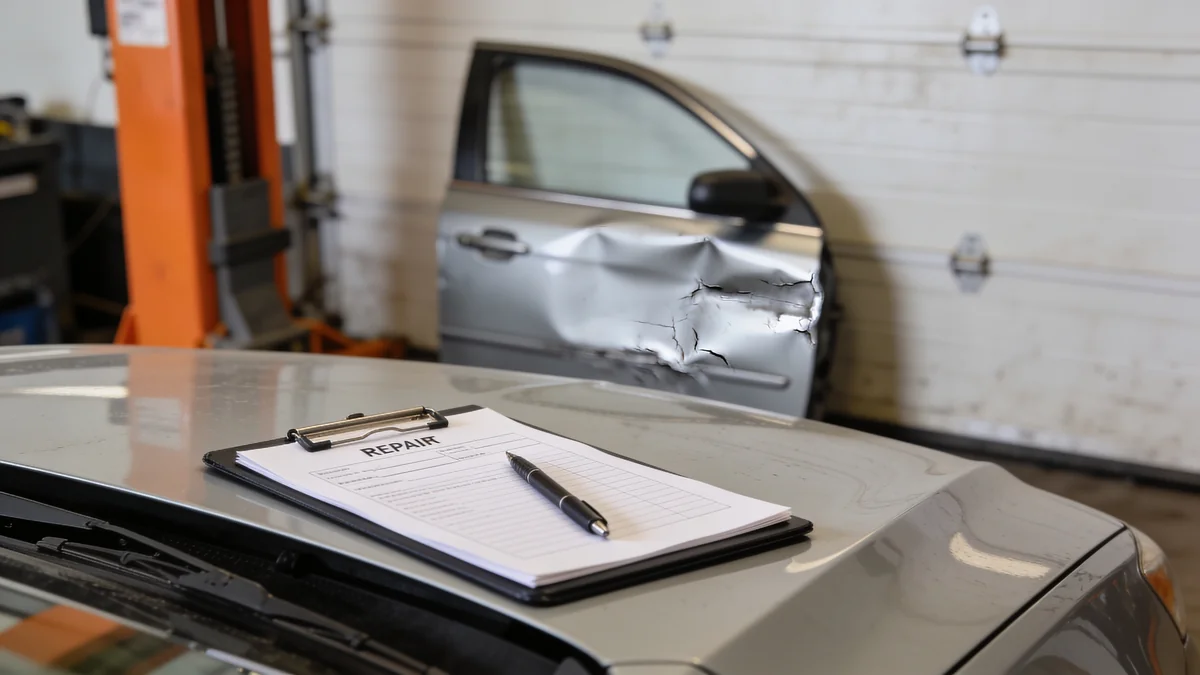
Your car took a hit and three words keep coming up on the phone: authorized, independent, approved. If you don't know which door to knock on, this is for that exact moment.
The three checks that decide it: Policy, Warranty, Wallet
The decision isn't one question; it's three checks in order.
The short answer to a debate as old as the industrial district is a formula: Policy → Warranty → Wallet. First check what your policy says, then whether the car is under warranty, and only then your budget. Break that order and you burn either money or warranty.
Below we separate the concepts first, then run the formula through real scenarios.
"Approved" is not a type of shop
The most common mix-up: treating two separate axes as one list.
Authorized and independent describe a shop's identity. Approved describes a relationship: the shop has a contract with an insurance company. So "approved independent garage" packs two separate facts into one phrase.
| Shop | Who authorized it? | Strength | Weakness |
|---|---|---|---|
| Authorized service | The car manufacturer | Original parts, warranty safety | Premium labor and parts pricing |
| Independent garage | Nobody; it's your mechanic | Flexible pricing, fast turnaround | Standards vary shop to shop |
| Chain service | A franchise brand | Consistent process, receipts | May lack dealer-level equipment |
Your mechanic in the industrial district sits in the "independent" row. The shop may specialize in one brand and even paint that brand's name on the window; without an official tie to the manufacturer, it's independent.
The rule: whenever you hear "approved", ask: approved by which insurer? If the answer isn't your insurer, that agreement does nothing for you.
What the insurance agreement buys you
It decides who carries the paperwork after a casco claim.
At an approved shop, the flow works like this: the shop calls the insurer, the expert comes to them, the file opens there, parts and payment settle between shop and insurer. You drop the car off and pick it up. If your policy has a deductible, only that amount is yours.
You can use casco at a non-approved shop too, but then you chase the file yourself; if an approval stalls, the car waits. On a busy week that difference is worth a day off.
Repairs at authorized services cost insurers more. That's why policies limited to approved independent shops usually come cheaper, while "any authorized service" rights push the premium up. Read that clause before renewing.
Pro tip: when buying the policy, ask one sentence: "Which shops can I use in a claim?" Get the answer in writing; it ends the argument before it starts.
Decide by scenario
The formula in the field: Policy → Warranty → Wallet.
| Situation | Right door | Why |
|---|---|---|
| Under warranty, casco claim | Approved authorized service | Warranty stays intact, insurer handles paperwork |
| Warranty over, casco claim | Approved independent garage | Nothing out of pocket, quick turnaround |
| Warranty over, damage not covered | An independent garage you trust | Best price and workmanship balance |
| Warranty running, routine maintenance | Authorized service | A warranty condition for most brands |
That "garage you trust" row is its own craft; we broke it down step by step in how to choose a mechanic.
Three mistakes people keep making
Short ones, because each fix is a single sentence.
Opening the job at the shop first and calling the insurer second. The order is the reverse: insurer first, shop second, or you risk a "non-approved procedure" rejection.
Getting engine work done at a garage while the car is under warranty. Even clean work won't show in the warranty records and will haunt a future claim.
Trusting the word "approved" alone. The shop may well be approved, just by a different company. Verify against your own insurer's list; it lives on their website and call center.
Bottom line: know your policy, protect your warranty, then choose by wallet. You can check nearby shops' price lists and supported brands in Sanayile before the bad day comes.